


From Sea Battle to Pentium:
12 Gaming Platforms of the Soviet and Post-Soviet Era. Part 1
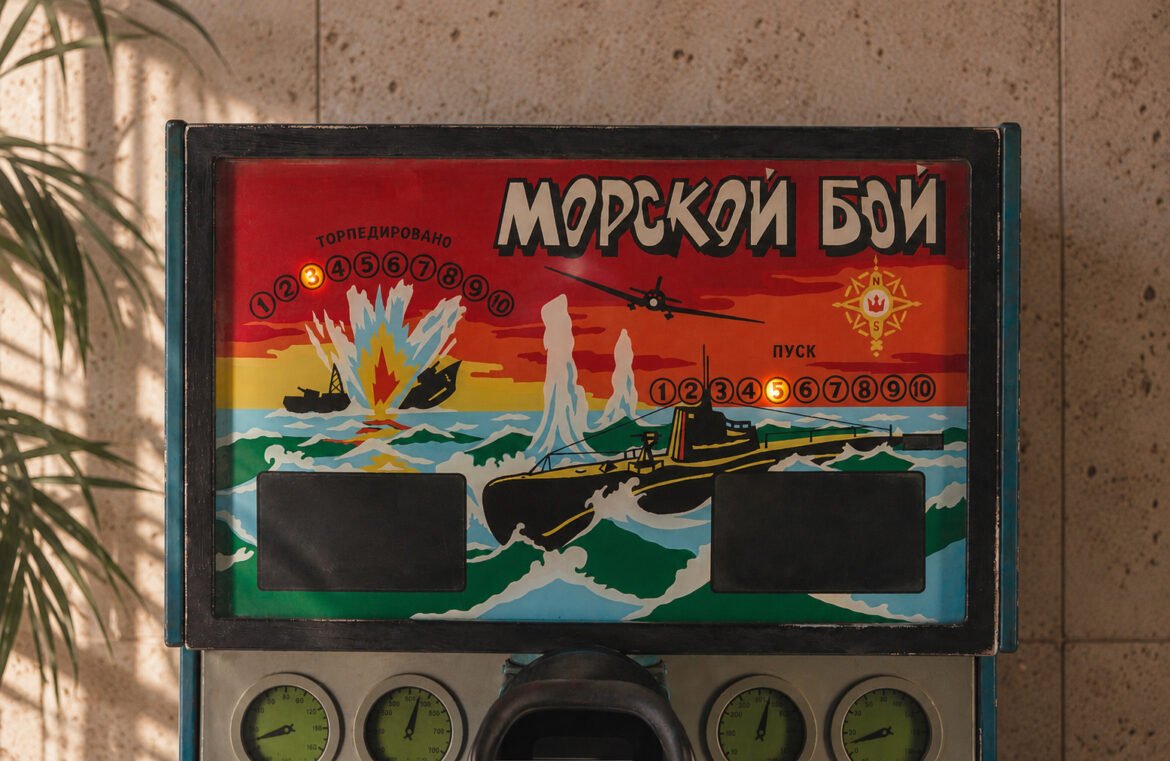
When people think of the Soviet Union, they usually think of Kalashnikov rifles, tanks, space rockets or, at a stretch, Lada cars. Video games hardly seem to belong on that list. And yet the USSR did have a gaming culture of its own — it simply developed very differently from that of the West. Against the backdrop of the Cold War and limited access to Western electronics, an unusual gaming ecosystem emerged. Arcade machines were produced mainly by defense-industry factories, games were written even for programmable calculators, and radio amateurs and engineers spent years squeezing everything they could out of the Soviet equivalent of the Intel 8080 processor, long after it was already becoming obsolete in the West. At the same time, radically different solutions could exist alongside it — such as the affordable 16-bit BK-0010 home computer, based on the architecture of the American PDP-11 minicomputer. Software was freely copied and passed from hand to hand, while local games were often written by schoolchildren themselves, staying behind in computer labs after classes. As a result, the Soviet history of video games and home computers did not develop simply as a belated copy of the Western one, but followed its own, often rather unexpected path. The twelve platforms in this article trace that journey — from the electromechanical Morskoi Boi (Sea Battle) to the Pentium era in the post-Soviet countries.
1. The Morskoi Boi Electromechanical Arcade Machine
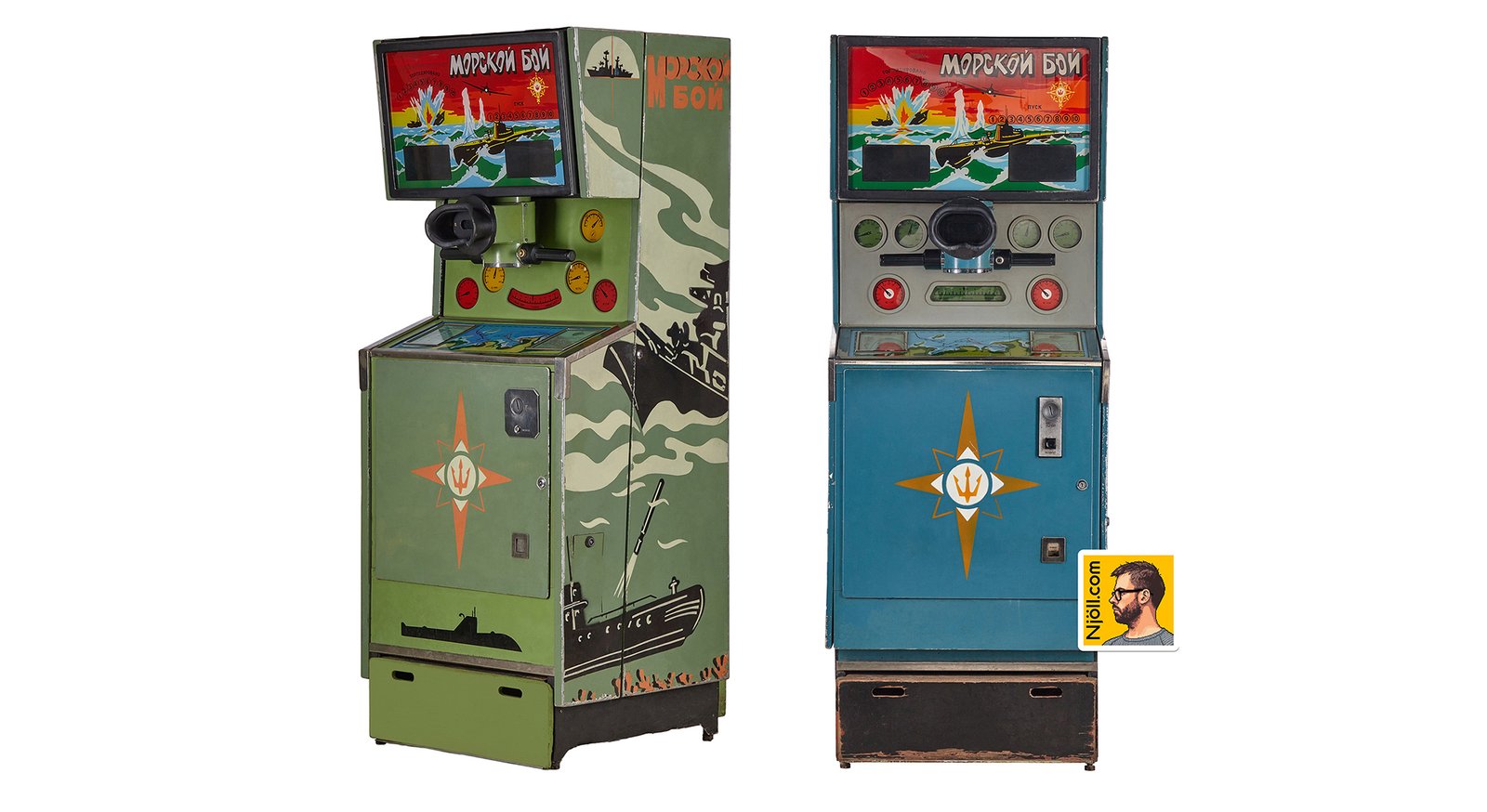


The concept of an “entertainment industry” entered Soviet usage in the early 1970s. An important event was the international Attraction-71 exhibition, held in Moscow in 1971 and attended by participants from 11 countries, including the United States and Japan. At the exhibition, the specialised organisation Soyuzattraktsion had an opportunity to study some of the best examples of foreign amusement technology and later began organising the production of Soviet equivalents.
In many cases, Soviet arcade machines were created in much the same way: a foreign machine was purchased, its construction was studied, and then a domestic equivalent was developed. Engineers tried to make the design cheaper and adapt it to local conditions, often removing unnecessary decoration and simplifying individual components.
Soyuzattraktsion placed its orders throughout the USSR, often with defenceindustry factories whose equipment and highly skilled workers made it possible to manufacture complex machinery. At first, Soviet arcade machines were electromechanical. Electronic machines, based first on discrete logic and later on microprocessors, appeared afterwards.
Among the earliest and arguably most successful were the electromechanical Morskoi Boi (Sea Battle), manufactured by the Ratep plant in Serpukhov, and Sniper, made by the Prompribor production association in Cheboksary. Altogether, dozens of different Soviet arcade machines existed: shooting galleries, car and motorcycle racing games, sports machines, pinball tables, and prize grabbers in which a mechanical “hand” could pick up an object and pull it out.
They could be found not only in dedicated amusement arcades and recreation parks, but also in cinemas, cafés, and even in institutions for children.
While some machines in a cinema lobby might stand deserted for long periods, trying to attract players with the slow blinking of their lights, Morskoi Boi was almost always surrounded by boys in school uniforms. Small windows at the top of the cabinet allowed spectators to follow the action, and those waiting in line craned over one another’s shoulders to see what was happening inside.
And this was what they saw: ship silhouettes moving slowly across the horizon, seemingly in jerks, while the player tried to hit them with a torpedo represented by a blinking dotted line of light.
With his face pressed against the rubber eyepiece of the periscope, turning it almost with his entire body, the player aimed the “weapon”, trying to judge the difference in speed and fire with the correct lead. If the torpedo hit its target, the ship was engulfed in a flash accompanied by a loud bang, simulating an explosion. It would then turn around and continue moving in the opposite direction.
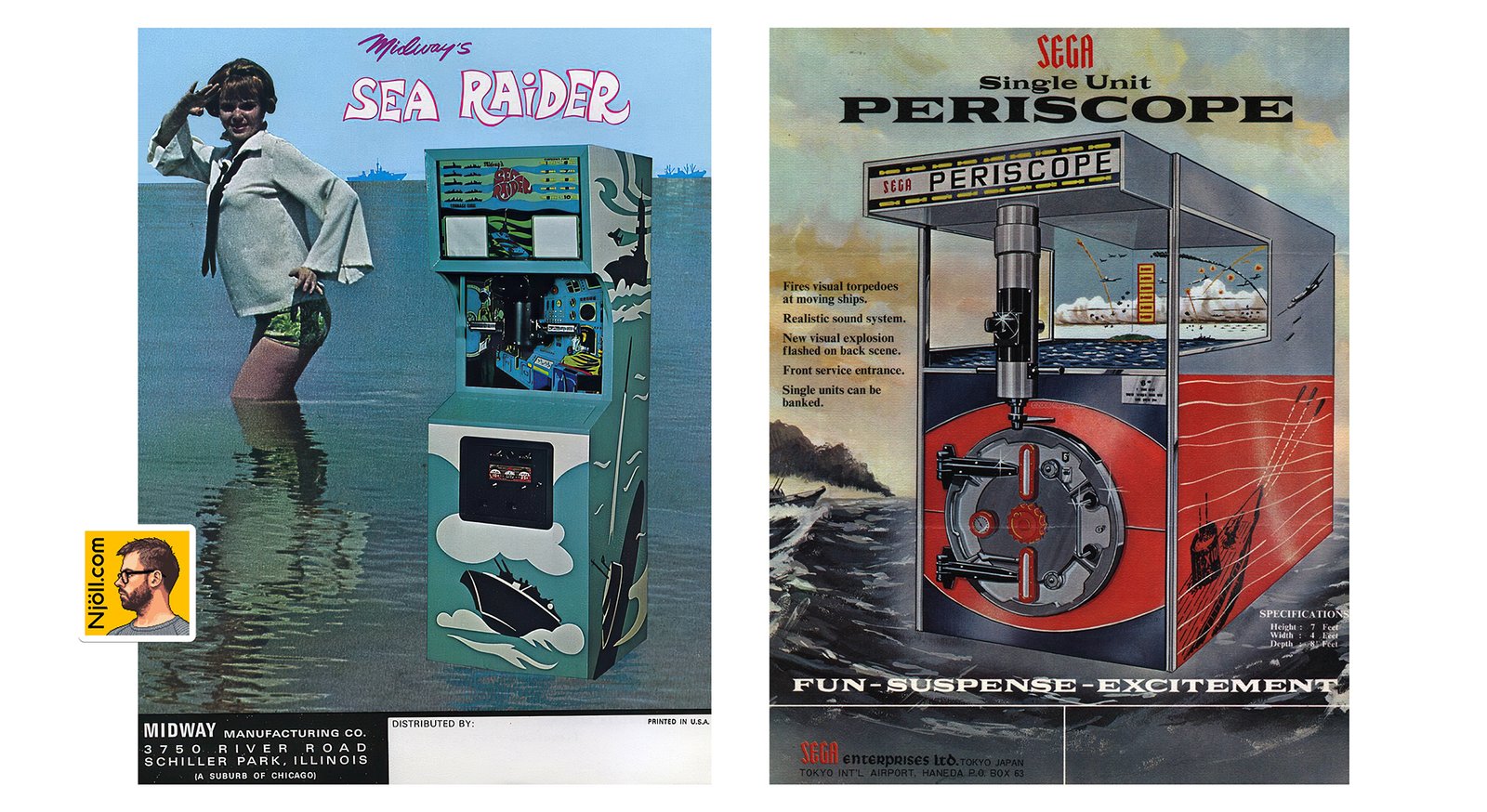
The Japanese were the first to turn the idea of a torpedo-attack arcade machine into reality — specifically Nakamura Seisakusho Co. Ltd. (later Namco) and Sega. Which company was actually first is not known with certainty, as almost no documentary evidence has survived. Namco dates its Periscope to 1965, while Sega dates its machine to 1966. Remarkably, the two machines, both carrying the same name, were very similar both technically and visually.
The Soviet Morskoi Boi, however, was not copied directly from Periscope, but from a more modern relative of it — Sea Raider, produced by the American company Midway Manufacturing.
Impressed by the success of the Japanese Periscope, Midway’s designers decided to make a much more compact machine that would not discourage potential customers with limited floor space. The original Periscope, even in its single-player version, was enormous: the enemy ships were physically positioned a considerable distance away from the player.
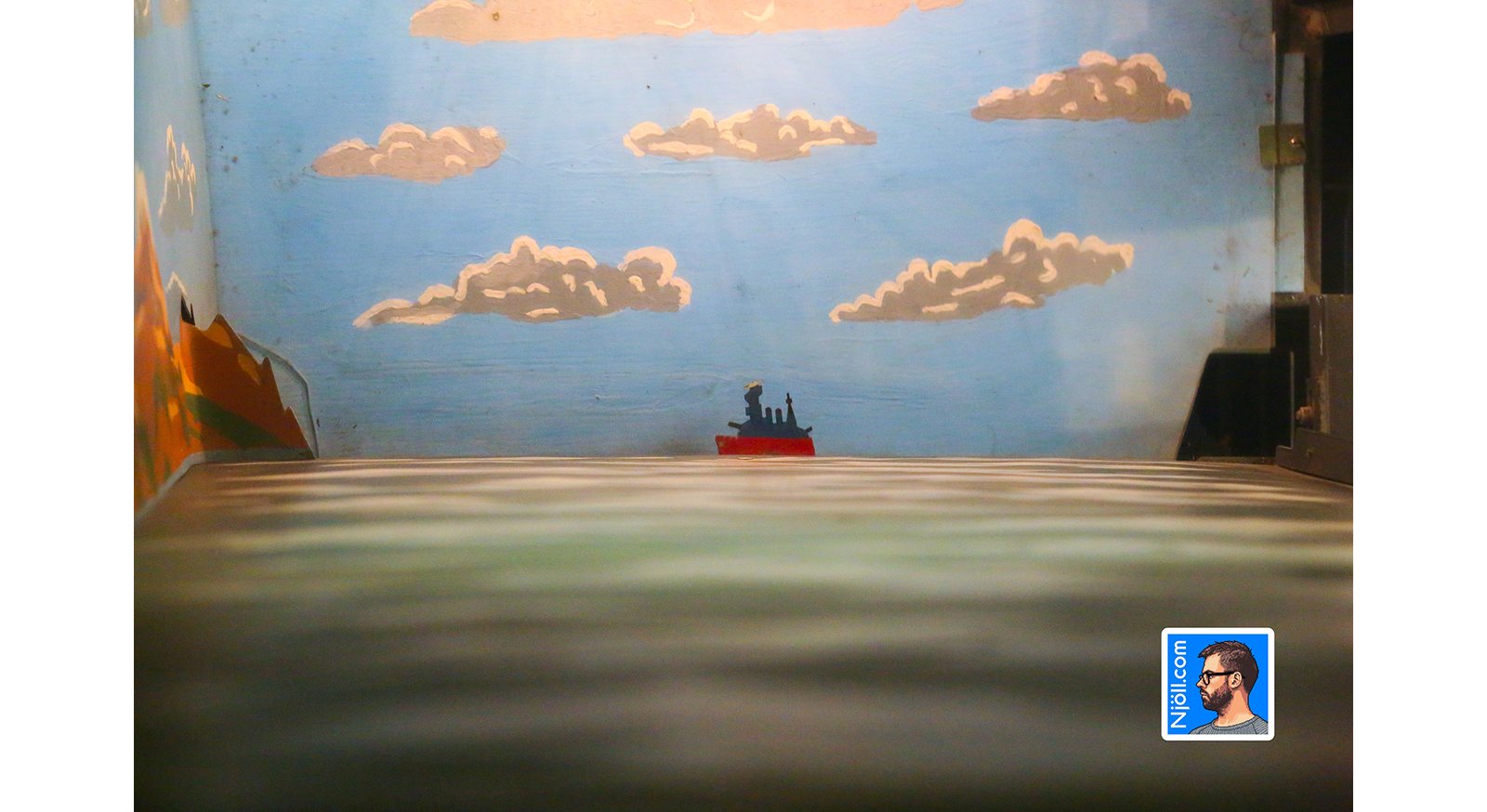
When you look into the periscope of Sea Raider or Morskoi Boi, the ships also seem to be far away, somewhere on the horizon. How did the engineers achieve this effect? The solution was surprisingly simple. The scene was actually located not in front of the player, as in Periscope, but in the lower part of the cabinet. The background, with mountains and clouds painted on it, was positioned almost at the player’s feet, while the image seen through the periscope was reflected in a special mirror.
2. Pong TV Console Clones
Pong is one of the few video games of the 1970s that can still be genuinely enjoyable today, especially when played by two people. Its extremely simple blackand-white graphics do nothing to diminish its appeal. Is that not the mark of a true timeless classic?
In the West, Pong became one of the main symbols of the birth of the massmarket video game industry. Atari’s Pong arcade machine was an enormous commercial success, and it was followed by numerous home TV consoles offering variations of electronic tennis.
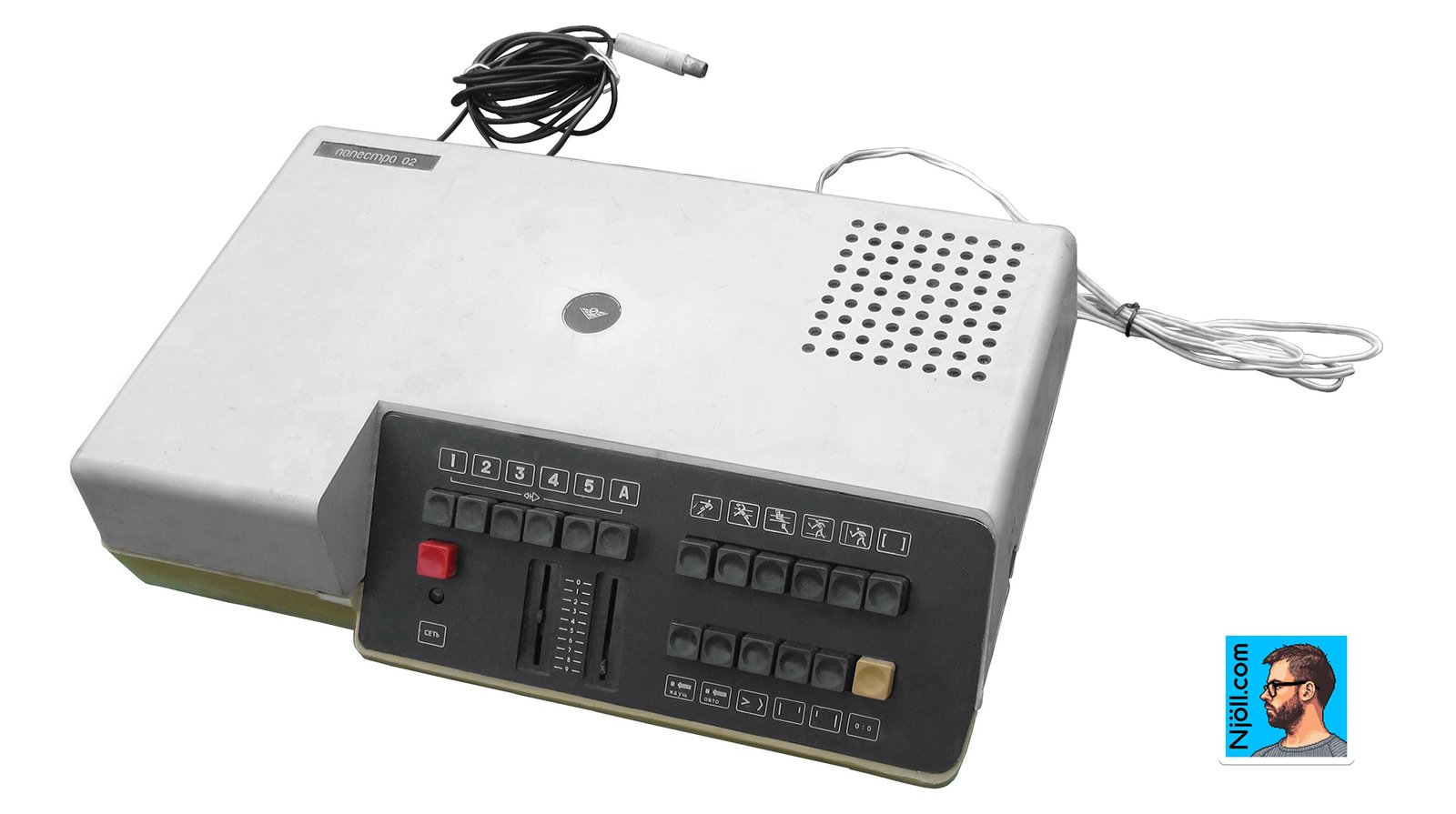
The first mass-produced Soviet TV game console appeared in 1978. The V. I. Lenin Production Association in Lviv — today known as the Lorta plant and involved, among other things, in producing radio-electronic equipment for Soviet air-defence forces — released the Palestra-02 game console.
The logic behind the name is easy to understand. In Ancient Greece, a palaestra was a private school for physical training, and since the main game was video tennis and its variations, the console could be regarded as a kind of electronic sport. It was, after all, genuinely intended to develop speed and accuracy of reaction.
The Palestra was a large box — almost 40 centimetres wide — and a heavy one, weighing around four kilograms. By the time it appeared, most new Western Pongtype consoles were already built around a single specialised integrated circuit, most commonly the General Instrument AY-3-8500, which implemented almost all of the game logic. In the Palestra, the same task required several circuit boards carrying dozens of ordinary logic chips. This large number of components affected both the retail price — around 200 roubles — and reliability: there was certainly plenty inside that could go wrong.
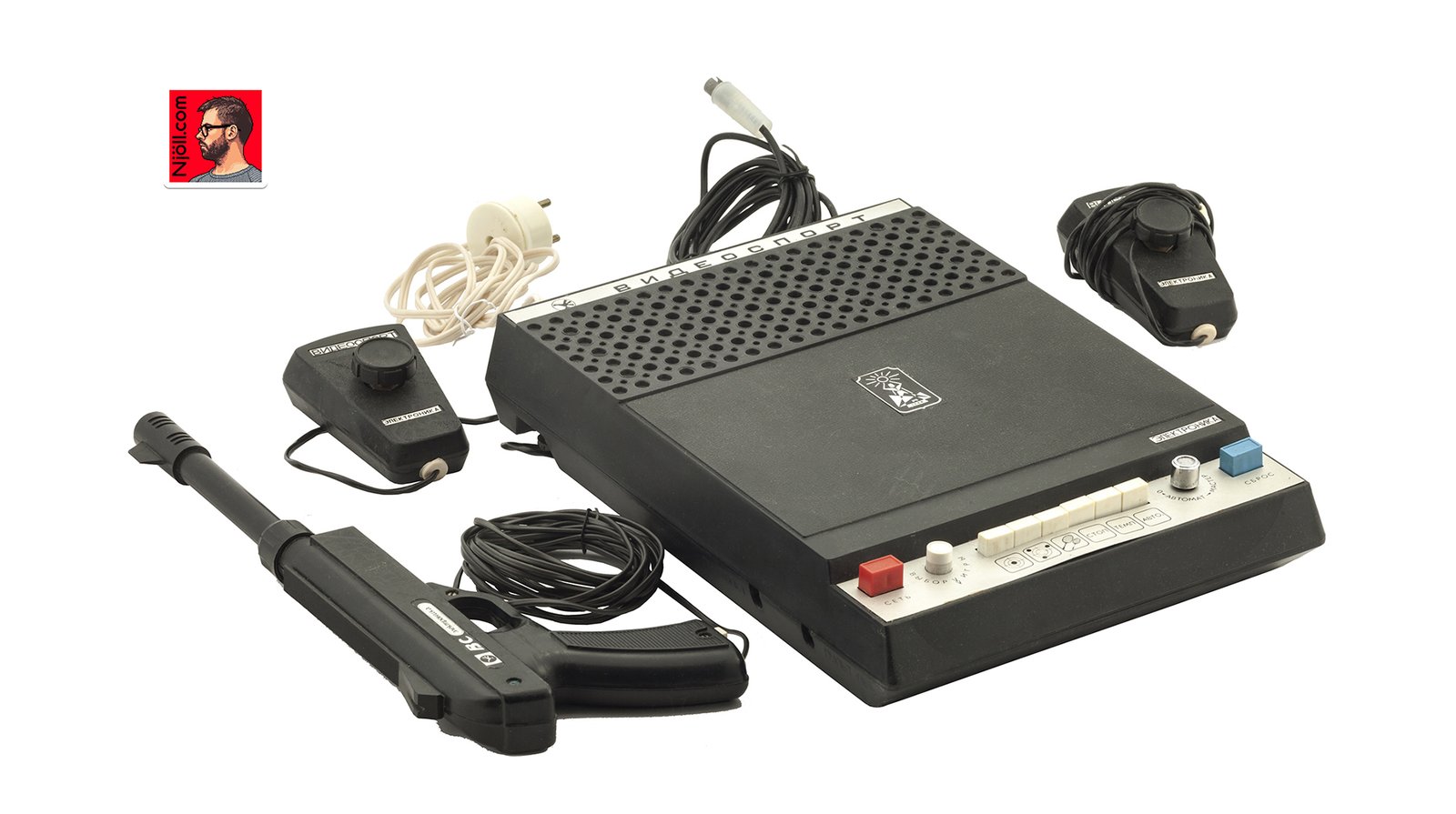
After the Palestra, other Soviet factories began producing game consoles of their own. Later models already used specialised integrated circuits such as the K145IK17, a functional equivalent of the AY-3-8500, which made them considerably smaller and cheaper.
The most widespread of these was the Videosport, produced in several versions. The Videosport-3 even came with a light gun. Nevertheless, home video game consoles never became truly mass-market entertainment in the USSR. The real console boom began only after the collapse of the Soviet Union, with the arrival of Dendy — a Nintendo Famicom clone — in the early 1990s.
3. Elektronika Programmable Calculators
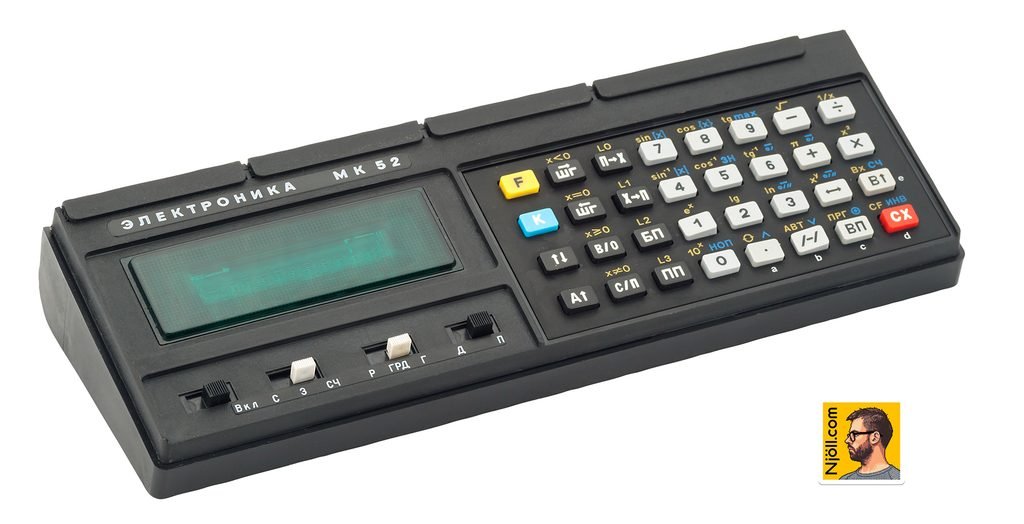
Programmable microcalculators, known in Russian by the abbreviation PMK, appeared in Soviet shops much earlier than home computers, as far back as the late 1970s. By the mid-1980s, when their prices had fallen considerably, they had become quite popular, including among schoolchildren whose parents could afford to spend 100–150 roubles on such a device — either for themselves or for a child showing promise in mathematics and the sciences.
If an uninitiated person tried to perform a calculation on what looked like an ordinary calculator, they were often surprised to discover that the familiar sequence of operations did not work. To add 4 and 5, for example, you first pressed 4, then the arrow key, then 5, and only then +. This method is known as Reverse Polish Notation.
But the main difference from an ordinary calculator was not the input method. It was programmability. Programs were entered directly through the calculator’s keyboard.
Alongside serious programs for mathematical, engineering and other tasks, there were also games. Despite the lack of conventional graphics, a remarkable variety was created: logic games, strategy games, adventures and even unusual forms of arcade games and simulators. Almost everything that happened had to be visualised in the player’s imagination, of course, and much of the entertainment depended on the player’s own fantasy.
So what was the gameplay actually like?
First, you had to enter the program code — sometimes a fairly long sequence of commands. Mistakes were best avoided: the program might simply fail to run, forcing you to find the error or enter the whole thing again. And if the calculator happened to switch off while you were entering the code, the program was lost.
Non-volatile memory, allowing a program to be stored and loaded again later, appeared in the Elektronika MK-52 model in 1985. This calculator was even included among the equipment aboard the Soyuz TM-7 spacecraft as a backup computing device in case the standard onboard systems failed.
Imagine running one of the better-known calculator games, Star Fighter. At first, incomprehensible characters and numbers flicker across the display, and then the same message appears:
“8. – 8 –”
The game has already begun. You are in outer space.
To understand what the display means, you first have to read the instructions. The first 8 means nothing — its appearance is simply a feature of the calculator’s interface. The second 8 is the gunsight. The dashes on the left and right are enemy unmanned probes.
There are other enemies as well: “L” represents light fighters, “C” medium fighters, “Г” heavy fighters and “Е” escort ships. There is probably little point in describing the gameplay in greater detail. Few people today would want to play games with almost no interface at all. But at the time, they were like a window into a parallel universe, and even the process of entering program code could feel like a genuine ritual.
Where could you get these programs?
First of all, from popular magazines. Tekhnika — Molodyozhi (Technology for the Youth), Nauka i Zhizn (Science and Life), Khimiya i Zhizn (Chemistry and Life) and other publications had regular sections devoted to programmable calculators, where program listings — including games — were published.
Second, dozens of specialist books appeared during the 1980s.
And, of course, users copied programs from one another, notebook to notebook. There were almost no universally accepted standards for writing down program code, however, so even a neat listing copied from someone else could take some effort to decipher.